Jocelyn Bell

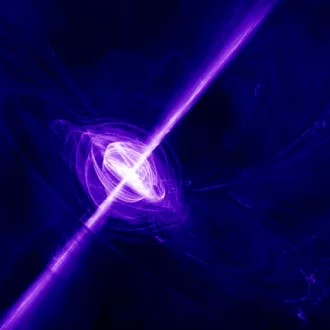
Illustration of a pulsar

Pulsar

Cosmic Lighthouses and Clocks of the Universe

Imagine a cosmic lighthouse spinning at a dizzying speed in the vastness of space. Pulsars are ultra-dense neutron stars that emit beams of electromagnetic radiation. When these beams sweep across Earth, we detect regular radio pulses, as precise as an atomic clock.

Learn more about Jocelyn Bell

Video of a pulsar: beam emission

What is a pulsar?

Imagine a cosmic lighthouse spinning at a dizzying speed in the vastness of space. That's exactly what a pulsar is: an ultra-dense neutron star that emits beams of electromagnetic radiation while rotating on its axis. When these beams sweep across Earth, we detect regular radio pulses, as precise as an atomic clock. The name "pulsar" comes from this characteristic: pulsating star.

Ultra-dense

A teaspoon of pulsar matter weighs several billion tons. It's the density of an atomic nucleus extended to the scale of a city!

Extreme rotation

Some pulsars rotate more than 700 times per second. At this speed, their equator moves at approximately 10% the speed of light!

Clock-like precision

Pulsars are so regular that they rival the best atomic clocks. This precision makes them valuable tools for testing fundamental physics.

The formation of a pulsar

  1. A massive star (at least 8 times the mass of the Sun) reaches the end of its life and exhausts its nuclear fuel.
  2. The star explodes as a supernova, releasing in a few seconds as much energy as our Sun in 10 billion years.
  3. The core collapses: protons and electrons merge to form neutrons, creating a neutron star (the pulsar).
  4. By conservation of angular momentum, the object begins to spin faster and faster, like a figure skater pulling in their arms.